Conor McPherson is hailed as the finest contemporary Irish playwright, and I think that title is well-deserved. The Weir was my first experience with him. The moment I walked out of the wee little theatre on H Street, I knew I was going to be finding the rest of his plays and reading them. He has this beautiful style of writing that can start out with casual banter back and forth at the bar to long, narrative stories of spirits and faeries. It reminded me very much of my own family. The Gallaghers come from County Donegal in western Ireland, and when you get us together, you are bound to hear us making fun of each other, telling stories, and getting into deep conversations that last hours. McPherson, in his 2-hour play, not only puts all of those things on stage but nails them. Being in the audience was like being at a bar with my uncles.
This is just the homiest little set you've ever seen. None of the chairs at the tables match, there's a picture of the Pope behind the bar, and comforting, familiar beers are on tap (Harp and Guinness, two of my own personal favorites). Jack and Brendan (Gordon Fulton and Eric Lucas, respectively) enter, gossiping about their friend Finbar (Brian Mallon), a married man who's been seen escorting a new neighbor around town. This new neighbor just happens to be a lovely woman named Valerie (Kerry Waters Lucas) who recently moved down from Dublin - alone. Soon, Jim (Barry McEvoy) arrives at the bar bringing more news - that Finbar is bringing Valerie to the bar that very night! When the pair arrives, the subject of spirits and faeries comes up in conversation, leading to a soul-crushingly sad story about one of the characters' past. I won't tell you what happens - you have to go see it for yourself!
Three of the five actors are originally from Ireland - Fulton, Mallon and McEvoy. Going in, I didn't know which of the actors were faking their accents and which weren't, and I'll admit that I definitely guessed wrong. Beyond that, the actors were fantastic. You could tell that their characters had been friends for a long time, and when Valerie arrived there was a definite awkwardness of having a new person in the midst of very close friends. I was just transfixed the whole time by the language and the accents and the actors. 30 minutes in, I'd abandoned my notebook and was just letting the world of the play wash over me. It was awesome. 4 stars.
The Weir
by Conor McPherson
produced by SCENA Theatre
at H Street Playhouse
running through April 24
Monday, March 28, 2011
Thursday, March 24, 2011
Blogger preview: Liberty Smith at Ford's Theatre
On Sunday night, Ford’s Theater held another of its blogger previews for Liberty Smith, a world premiere musical set to have its official opening at Ford’s next week. I was able to attend the first half hour of the technical rehearsal and started to get a feel for the show.
Liberty Smith has a pretty simple concept- what if there was a founding father we’ve never heard of? That would be Liberty, a normal guy who managed to meet most of the key figures in the American Revolutionary War and seems to be responsible for most of it getting off the ground in the first place. Geoff Packard plays Liberty, a tremendously talented actor last seen as the title character in the Shakespeare Theatre Company’s Candide, and it’s great to have him back on DC stages (even if he IS sporting a really unfortunate brown wig as Liberty). The ensemble features plenty of familiar names from the DC musical theatre scene and the set, by Court Watson, is fun and versatile, with lots of metatheatrical flourishes.
Here are a few shots from the rehearsal to give you a sneak peek:

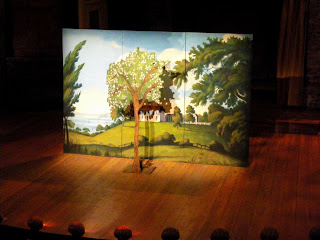
Our show is, technically, half play within a play, half... well, play. This painted backdrop is from the framing story: a play about George Washington being performed in the 1800s.

The play gets quickly interrupted by Drew Eshelman, as Liberty Smith, with Thomas Adrian Simpson, Noah Chiet, and Tracy Lynn Olivera

Geoff Packard as young Liberty, and Drew Eshelman as the older Liberty

Packard as Liberty (right) with his childhood friend George Washington (Gregory Maheu)

The ensemble
We're looking forward to seeing the show once it opens! Check back here for our official review
Liberty Smith has a pretty simple concept- what if there was a founding father we’ve never heard of? That would be Liberty, a normal guy who managed to meet most of the key figures in the American Revolutionary War and seems to be responsible for most of it getting off the ground in the first place. Geoff Packard plays Liberty, a tremendously talented actor last seen as the title character in the Shakespeare Theatre Company’s Candide, and it’s great to have him back on DC stages (even if he IS sporting a really unfortunate brown wig as Liberty). The ensemble features plenty of familiar names from the DC musical theatre scene and the set, by Court Watson, is fun and versatile, with lots of metatheatrical flourishes.
Here are a few shots from the rehearsal to give you a sneak peek:
Our show is, technically, half play within a play, half... well, play. This painted backdrop is from the framing story: a play about George Washington being performed in the 1800s.
The play gets quickly interrupted by Drew Eshelman, as Liberty Smith, with Thomas Adrian Simpson, Noah Chiet, and Tracy Lynn Olivera
Geoff Packard as young Liberty, and Drew Eshelman as the older Liberty
Packard as Liberty (right) with his childhood friend George Washington (Gregory Maheu)
The ensemble
We're looking forward to seeing the show once it opens! Check back here for our official review
Wednesday, March 16, 2011
STC's An Ideal Husband
Keith Baxter’s production of Oscar Wilde’s An Ideal Husband begins with a giant coin projected on the curtain, highlighting the play’s economic concerns. This coin is repeated in the circular design of the set, and as the curtain rises we see the various cast members frozen in poses across the set, and we hear the sound of minor chords.
The production has a mostly solid cast, covered in lavish costumes (Robert Perdziola), striding across a majestic set (Simon Higlett). A couple of the actors make the parts their own in ways that seem surprising but ultimately turn out successful. Mabel (Claire Brownell) is awkwardly intense, seemingly out of place in this world and knowing it. Lord Goring (Cameron Folmar) is less of a devilish charmer than you might expect, more fop than rake, but his true heart and character shine through in the second half. Mrs. Cheveley (Emily Raymond) out-charms everyone else onstage, and it is certainly her scenes that are the best (the dress she wears on her first entrance is breathtaking).
Like his production of Mrs. Warren’s Profession, director Keith Baxter takes liberties with the staging, suggesting a more cynical view than the author originally intended. The way the ending is staged clearly demonstrates Baxter’s particular view of the play, so here there be spoilers.
Here’s how the play ends in Wilde’s script:
Here’s how Baxter’s production ends:
Robert Chiltern is sitting in a chair stage left, looking defeated. The other characters leave and Gertrude follows. She gets halfway up the grad staircase and turns back, and says “Aren’t you coming in, Robert? They’re waiting for you.” (I’ve written in my notes just “they’re waiting for you” which means either it exists in a different version of the script, the line was added, or I wrote something down wrong – I’m not sure which, maybe Emily or Emma can clarify if they see the play…)
She delivers the line from the stairs, coming no closer. It becomes an action of magnanimity, rather than of love. You can’t help but think that if she truly loved Robert, and truly understood him, she would recognize his despair and go to him. She doesn’t, and her words seem to provide no comfort to Robert.
We hear the dissonant chords from the beginning of the play, and Robert stands slowly, a man alone. As he walks to the staircase, the other characters fill the stage, watching him. The sound of the song “For he’s a jolly good fellow” grows, and takes on an ominous aspect. As Robert reaches the stairs, climbing to the middle, then turning to the crowd, you get the feeling we are seeing him in his public life, perhaps the moment he is elected prime minister? Though he is surrounded by people cheering for him, he is isolated, left alone with his guilt.
I support the artistic license of the director, and I believe in making strong choices, though this one seems to go against the very nature of the play (and perhaps that is Baxter’s intention). Wilde was famously a proponent of art as entertainment, art with no further purpose. His plays are devoid of the seriousness and sadness that Wilde encountered in his own life. His characters avoid tragedy merely with a smart turn of verbal phrase.
As a result, Baxter’s ending seems strangely out of place. Other than the repeated musical motif from the beginning of the play, almost nothing else in the staging prepares the audience for the loneliness of the ending.
It is hard not to notice that Baxter has directed Gertrude and Robert to never touch during the course of the play. That kiss in Wilde’s script never happens. Their marriage is portrayed as incredibly chaste, their relationship based on a noble love, rather than any passion. Certainly it’s a valid characterization, but it sure makes it hard to care about the couple.
Baxter’s ending doesn’t leave you uplifted, but it doesn’t quite accomplish his goal of leaving you distrustful. Instead, I just felt confused. Still, I’ll take an interesting choice that gives me something to think about over a standard, uninspired one any day, and I’m certainly excited to find out how others responded to the play.
3 stars
Through April 10
The production has a mostly solid cast, covered in lavish costumes (Robert Perdziola), striding across a majestic set (Simon Higlett). A couple of the actors make the parts their own in ways that seem surprising but ultimately turn out successful. Mabel (Claire Brownell) is awkwardly intense, seemingly out of place in this world and knowing it. Lord Goring (Cameron Folmar) is less of a devilish charmer than you might expect, more fop than rake, but his true heart and character shine through in the second half. Mrs. Cheveley (Emily Raymond) out-charms everyone else onstage, and it is certainly her scenes that are the best (the dress she wears on her first entrance is breathtaking).
![]() |
| Emily Raymond as Mrs. Cheveley and Gregory Wooddell as Sir Robert Chiltern in the Shakespeare Theatre Company’s production of An Ideal Husband, directed by Keith Baxter. Photo by Scott Suchman. |
Like his production of Mrs. Warren’s Profession, director Keith Baxter takes liberties with the staging, suggesting a more cynical view than the author originally intended. The way the ending is staged clearly demonstrates Baxter’s particular view of the play, so here there be spoilers.
Here’s how the play ends in Wilde’s script:
[They all go out except Sir Robert Chiltern. He sinks in a chair, wrapt in thought. After a little time Lady Chiltern returns to look for him.]
Lady Chiltern. [Leaning over the back of the chair.] Aren’t you coming in, Robert?
Sir Robert Chiltern. [Taking her hand.] Gertrude, is it love you feel for me, or is it pity merely?
Lady Chiltern. [Kisses him.] It is love, Robert. Love, and only love. For both of us a new life is beginning.
Curtain.
Here’s how Baxter’s production ends:
Robert Chiltern is sitting in a chair stage left, looking defeated. The other characters leave and Gertrude follows. She gets halfway up the grad staircase and turns back, and says “Aren’t you coming in, Robert? They’re waiting for you.” (I’ve written in my notes just “they’re waiting for you” which means either it exists in a different version of the script, the line was added, or I wrote something down wrong – I’m not sure which, maybe Emily or Emma can clarify if they see the play…)
She delivers the line from the stairs, coming no closer. It becomes an action of magnanimity, rather than of love. You can’t help but think that if she truly loved Robert, and truly understood him, she would recognize his despair and go to him. She doesn’t, and her words seem to provide no comfort to Robert.
We hear the dissonant chords from the beginning of the play, and Robert stands slowly, a man alone. As he walks to the staircase, the other characters fill the stage, watching him. The sound of the song “For he’s a jolly good fellow” grows, and takes on an ominous aspect. As Robert reaches the stairs, climbing to the middle, then turning to the crowd, you get the feeling we are seeing him in his public life, perhaps the moment he is elected prime minister? Though he is surrounded by people cheering for him, he is isolated, left alone with his guilt.
I support the artistic license of the director, and I believe in making strong choices, though this one seems to go against the very nature of the play (and perhaps that is Baxter’s intention). Wilde was famously a proponent of art as entertainment, art with no further purpose. His plays are devoid of the seriousness and sadness that Wilde encountered in his own life. His characters avoid tragedy merely with a smart turn of verbal phrase.
As a result, Baxter’s ending seems strangely out of place. Other than the repeated musical motif from the beginning of the play, almost nothing else in the staging prepares the audience for the loneliness of the ending.
It is hard not to notice that Baxter has directed Gertrude and Robert to never touch during the course of the play. That kiss in Wilde’s script never happens. Their marriage is portrayed as incredibly chaste, their relationship based on a noble love, rather than any passion. Certainly it’s a valid characterization, but it sure makes it hard to care about the couple.
Baxter’s ending doesn’t leave you uplifted, but it doesn’t quite accomplish his goal of leaving you distrustful. Instead, I just felt confused. Still, I’ll take an interesting choice that gives me something to think about over a standard, uninspired one any day, and I’m certainly excited to find out how others responded to the play.
3 stars
Through April 10
Tuesday, March 15, 2011
The Chosen, Theatre J
There are 4 fantastic reasons to see The Chosen, Theater J's latest show in residence at Arena Stage. Those reasons are:
1 Ed Gero
2 Rick Foucheux
3 Joshua Morgan
4 Derek Kahn Thompson
The cast brought together by Aaron Posner, with Aaron Davidman rounding out the ensemble, is incredible. Getting to see Gero and Foucheux share the same space, moving in and around each other but never actually meeting, is a treat, and Morgan and Thompson do excellent work as their respective sons (Morgan in particular has crafted a telling physicality for the role, carrying himself with a stiff reserve of pent-up energy that simmers under the surface and only bubbles over on rare occasions). Mr P's staging in Arena's space is generally serves the story well- it's a nice touch to be in the Fichlander, whose dimensions mimic the baseball diamond that sets the story in action.
But then, there's the "story" issue. Mr P is here directing his own adaptation of Chaim Potok's novel, and aside from giving us the opportunity to see these actors play these parts, I was never actually convinced this play needed to exist. What do we gain by transplanting the novel onto the stage? Not a whole lot, I'm afraid. It's not that it's a BAD play- I was engaged throughout. I laughed at the jokes and held my breath in the tense moments. I'm left thinking, however, that this is due far more to the actors than to the play's own merits, and that's not exactly the best feeling to walk away with. I gotta go with conflicted capslock on this one- I'm just not sure how strongly I can recommend this one.
I think that if you can make it, you should see The Chosen, and you should see it with this cast. I wonder if it would be nearly as enjoyable an experience with any other ensemble (hint: I don't think so). If you miss it, well, that's probably okay, too. Doesn't that say enough?
1 Ed Gero
2 Rick Foucheux
3 Joshua Morgan
4 Derek Kahn Thompson
The cast brought together by Aaron Posner, with Aaron Davidman rounding out the ensemble, is incredible. Getting to see Gero and Foucheux share the same space, moving in and around each other but never actually meeting, is a treat, and Morgan and Thompson do excellent work as their respective sons (Morgan in particular has crafted a telling physicality for the role, carrying himself with a stiff reserve of pent-up energy that simmers under the surface and only bubbles over on rare occasions). Mr P's staging in Arena's space is generally serves the story well- it's a nice touch to be in the Fichlander, whose dimensions mimic the baseball diamond that sets the story in action.
But then, there's the "story" issue. Mr P is here directing his own adaptation of Chaim Potok's novel, and aside from giving us the opportunity to see these actors play these parts, I was never actually convinced this play needed to exist. What do we gain by transplanting the novel onto the stage? Not a whole lot, I'm afraid. It's not that it's a BAD play- I was engaged throughout. I laughed at the jokes and held my breath in the tense moments. I'm left thinking, however, that this is due far more to the actors than to the play's own merits, and that's not exactly the best feeling to walk away with. I gotta go with conflicted capslock on this one- I'm just not sure how strongly I can recommend this one.
I think that if you can make it, you should see The Chosen, and you should see it with this cast. I wonder if it would be nearly as enjoyable an experience with any other ensemble (hint: I don't think so). If you miss it, well, that's probably okay, too. Doesn't that say enough?
Monday, March 14, 2011
Theatre J's The Chosen
Ten years after its original production, Theatre J is reviving everyone’s favorite Jewish bromance tale, The Chosen. Adapted from the classic novel by Chaim Potok by Aaron Posner, the play deals with politics and religion, and the relationships between two very different fathers and sons.
Theatre J is producing the play in residence at Arena Stage. So if you are seeing it, head to the waterfront, not 16th street. The production stars Rick Foucheux, Edward Gero, Aaron Davidman, Joshua Morgan, and Derek Kahn Thompson. All five ultimately give touching performances, but there is something holding this play back from truly grabbing hold of its audience.
Posner’s solution for adapting a novel into a play is to add a narrator character, the adult Reuven (Davidman). As a result, the continual narrator breaks up the flow of the actor and distances us from the characters. It’s a common problem in books-turned-into-plays, one that hinders The Chosen from reaching its full potential. So this post is going to be a bit more bloggy as opposed to reviewy, because I’d like to explore this aspect.
The problem with a narrator character is that it takes the creative burden off of the playwright. How do I make the audience understand this bit of information, or this bit of character development? Oh, I can just have the narrator say it. So instead of showing the audience, this script tells the audience. One example occurs when David Malter (Gero) is visiting his son in the hospital after the baseball accident. In the middle of the scene the adult Reuven breaks in to tell the audience that his father didn’t like the fact that he played baseball. Do we need to be told this? Why aren’t we allowed to just figure it out from the things David Malter says and the way Gero says them? This happens throughout the evening.
There also could have been a strong point of view in the way the narrator was used. If a play has a narrator, there needs to be a reason why the narrator is telling the story, and why the narrator is telling the story to us. Who are we to this person? What is the purpose of the story? What about the story requires it to be told via a narrator?
Reuven grows up and becomes a rabbi. So I would have found it more interesting if I had gotten the impression that this was all part of a sermon we were listening to at Reuven’s synagogue. The play begins and ends with adult Reuven talking about situations where “irreconcilable ideas are present … [where] both can’t be true and yet they are.” “Both these and these,” he says, holding out his hands.
The these and these he is referring to is immediately obvious, as he is standing in the middle of a stage with two distinct spaces, the study of Reb Saunders and the study of David Malter. Malter’s is messier, books everywhere, with modern furniture sporting clean, straight lines. Saunders’s study has traditional, ornate furniture, and everything is put into its specific place. The floor of the studies are lined with two squares that slightly overlap in the center of the stage. We see two different worlds coming into contact with each other. The set design (by James Kronzer) works well, for these squares also suggest a baseball diamond, the location of the inciting incident of the play. (And the Fichandler Stage is an appropriate space as well, since it too is in the shape of a square.)
So what if in the course of delivering a sermon on simultaneously true ideas, the adult Reuven relived the memories of how he came to learn this particular lesson? It is entirely possible that this is what director and adapter Aaron Posner was going for, but it didn’t come across in the staging.
Here’s why: there are two other moments in the script where speeches are given, and they are not handled consistently. At one point Reb Saunders is giving a sermon at his synagogue, and at another time David Malter is giving a speech in response to the holocaust. For this first speech, the fourth wall remains, and for the second it dissipates. In the second speech, the lights come up on the audience and we are cast as the audience for Malter’s speech. This is the only time in the production this happens, and I am confused why that sort of device wasn’t used a, to give more purpose to the narrator, and b, in the Saunders’s speech. The point of the scene with Saunders’s speech is to demonstrate the way he treats his son Danny in front of others, and to show a public test of Reuven. I think this could have been more powerful if we had specifically been made a part of that.
But like I’ve always said, I much prefer an imperfect production that makes me muse about the nature of theatre and the nature of the piece to a production that has no affect on me whatsoever. And I’m very interested in how others interpreted the use of the narrator and the single instance of casting the audience.
3 stars
Through March 27
(NB: You may note that my handle has changed. We decided at the recent blog meeting to use the Two Hours Traffic account for administrative tasks, so that there would be a separation from the blog itself and each of its writers – Charlene)
Theatre J is producing the play in residence at Arena Stage. So if you are seeing it, head to the waterfront, not 16th street. The production stars Rick Foucheux, Edward Gero, Aaron Davidman, Joshua Morgan, and Derek Kahn Thompson. All five ultimately give touching performances, but there is something holding this play back from truly grabbing hold of its audience.
Posner’s solution for adapting a novel into a play is to add a narrator character, the adult Reuven (Davidman). As a result, the continual narrator breaks up the flow of the actor and distances us from the characters. It’s a common problem in books-turned-into-plays, one that hinders The Chosen from reaching its full potential. So this post is going to be a bit more bloggy as opposed to reviewy, because I’d like to explore this aspect.
The problem with a narrator character is that it takes the creative burden off of the playwright. How do I make the audience understand this bit of information, or this bit of character development? Oh, I can just have the narrator say it. So instead of showing the audience, this script tells the audience. One example occurs when David Malter (Gero) is visiting his son in the hospital after the baseball accident. In the middle of the scene the adult Reuven breaks in to tell the audience that his father didn’t like the fact that he played baseball. Do we need to be told this? Why aren’t we allowed to just figure it out from the things David Malter says and the way Gero says them? This happens throughout the evening.
There also could have been a strong point of view in the way the narrator was used. If a play has a narrator, there needs to be a reason why the narrator is telling the story, and why the narrator is telling the story to us. Who are we to this person? What is the purpose of the story? What about the story requires it to be told via a narrator?
Reuven grows up and becomes a rabbi. So I would have found it more interesting if I had gotten the impression that this was all part of a sermon we were listening to at Reuven’s synagogue. The play begins and ends with adult Reuven talking about situations where “irreconcilable ideas are present … [where] both can’t be true and yet they are.” “Both these and these,” he says, holding out his hands.
The these and these he is referring to is immediately obvious, as he is standing in the middle of a stage with two distinct spaces, the study of Reb Saunders and the study of David Malter. Malter’s is messier, books everywhere, with modern furniture sporting clean, straight lines. Saunders’s study has traditional, ornate furniture, and everything is put into its specific place. The floor of the studies are lined with two squares that slightly overlap in the center of the stage. We see two different worlds coming into contact with each other. The set design (by James Kronzer) works well, for these squares also suggest a baseball diamond, the location of the inciting incident of the play. (And the Fichandler Stage is an appropriate space as well, since it too is in the shape of a square.)
So what if in the course of delivering a sermon on simultaneously true ideas, the adult Reuven relived the memories of how he came to learn this particular lesson? It is entirely possible that this is what director and adapter Aaron Posner was going for, but it didn’t come across in the staging.
Here’s why: there are two other moments in the script where speeches are given, and they are not handled consistently. At one point Reb Saunders is giving a sermon at his synagogue, and at another time David Malter is giving a speech in response to the holocaust. For this first speech, the fourth wall remains, and for the second it dissipates. In the second speech, the lights come up on the audience and we are cast as the audience for Malter’s speech. This is the only time in the production this happens, and I am confused why that sort of device wasn’t used a, to give more purpose to the narrator, and b, in the Saunders’s speech. The point of the scene with Saunders’s speech is to demonstrate the way he treats his son Danny in front of others, and to show a public test of Reuven. I think this could have been more powerful if we had specifically been made a part of that.
But like I’ve always said, I much prefer an imperfect production that makes me muse about the nature of theatre and the nature of the piece to a production that has no affect on me whatsoever. And I’m very interested in how others interpreted the use of the narrator and the single instance of casting the audience.
3 stars
Through March 27
(NB: You may note that my handle has changed. We decided at the recent blog meeting to use the Two Hours Traffic account for administrative tasks, so that there would be a separation from the blog itself and each of its writers – Charlene)
Saturday, March 12, 2011
Changes at Two Hours Traffic
Over the next few months you’ll be seeing some exciting changes here at Two Hours Traffic. We’ll be sprucing up our design and debuting some new features. Things to look forward to include:
We’ve also added an author tag to every post. Now you can quickly pull up a page with all the reviews written by a particular blogger.
Leave a comment and let us know if you have any questions for us, or if you have any theatre companies or artists you would like to learn more about. Also, let us know what plays you would like to read along with us!
- The return of the weekly discount post: every Monday we’ll be letting you know what free or affordable theatre you can attend that week. These posts will cover free play readings, pay what you can previews, and other similar events.
- Meet an Artist: once a month, starting in April, we’ll be doing a feature on a local theatre artist, an actor, director, playwright, or technician.
- Company Feature: once a month, starting in April, we’ll be doing a feature on a local theatre company. We hope to focus on some of the small professional companies that don’t get the attention they deserve.
- Read a play: Every month we’ll be reading a play and blogging about it. Read the play along with us and let us know your thoughts.
- Meet the Blogger: Look for individual posts soon introducing you to each of our bloggers.
We’ve also added an author tag to every post. Now you can quickly pull up a page with all the reviews written by a particular blogger.
Leave a comment and let us know if you have any questions for us, or if you have any theatre companies or artists you would like to learn more about. Also, let us know what plays you would like to read along with us!
Monday, March 7, 2011
ASC Actors' Renaissance Season
The Comedy of Errors -- 4 stars
Henry VI, Part 3 -- 4 stars
Look About You -- 3 stars
After spending another weekend in Staunton, Virginia, I must repeat the recommendation I always make: “Hie thee to the Blackfriars Playhouse!” If you have never been, you will discover Shakespeare anew. If you have been before, the troupe and the theatre continue to engage and entertain. Through the end of March, the American Shakespeare Center is performing its Actors’ Renaissance Season. This means there are no directors and no designers. Everything is determined by the actors, and they put the plays up with minimal rehearsal.
The Comedy of Errors, for example, had 20 hours of rehearsal, amazing when you consider the specificity of the physicalities. Naturally, things have evolved, grown, been dismissed over their two months of performances, but the continuity of the world created is a testament to these actors’ creativity and ability to work together.
The Dromios, played by Gregory Jon Phelps and Tyler Moss, are clowns. In red baseball caps, red suspenders, and oversized black pants, these two servants are always moving. But the movement is always defined and purposeful, which prevents the play from being derailed. Moss’s clown training is evident in the ease and boldness of his performance. For Phelps, the clown persona fits a little less well (but only slightly), but his understanding of the comedy inherent in the text, and how to delivery it vocally, keeps the laughs coming. A prime example is Phelps’s rapid-fire exchange with Antipholus of Syracuse about a kitchen wench so spherical one could find countries in her body. Antipholus asks, “Where stood Belgia? The Netherlands?” and Phelps pauses and continues slowly in quiet horror: “Oh. Sir. I did not look so low.”
In contrast to the Dromios are the Antipholi, and John Harrell and Patrick Midgley give the clearest characterizations for these roles that I have ever seen. I completely saw Antipholus’s status as important citizen of Ephesus, which makes it all the more comical when things start crashing down around him. These Antipholi were elegant, deliberate men, dressed in nice slacks and purple vests. Midgley in particular nails the part of straight man, and the biggest laughs in the first half of the play are more due to his stillness, than the other characters antics.
I’ve always had it in my head that I didn’t like The Comedy of Errors as a play very much, and I’ve discovered that this isn’t true. It’s not very deep, sure, and no one dies, but that’s not the kind of play it is. It’s fun and light, and it’s brilliant at being so. Working on the play gave me a grudging respect for it, and this production has furthered that. It’s very possible to find an unfunny production, or a production that tries to create the funny, rather than trusting Shakespeare’s funny, but when it’s done well, as it is here at the American Shakespeare Center, the delightful minutes fly by.
This troupe also understands the brilliance of Henry VI, part 3. The Henry VI plays are too often dismissed as lesser Shakespeare, but there’s a lot there to admire. I love them (I’ve seen some version of them four times now), and I always want everyone else to love them as well. Henry VI, part 3’s greatest strength is in the way Shakespeare juxtaposes scenes of great frenetic energy with introspective soliloquies. It’s what makes this script rev up your excitement and pull at your heartstrings, and the actors at the American Shakespeare Center nail this element.
The political and battle scenes are played at a high dramatic frenzy with percussive underscoring. It’s quickly clear which are the more capable actors, for being able to find vocal and emotional coloring while remaining at a high intensity is difficult. Paul Jannise, Jeremy West, and Jeremiah Davis, are capable with the text, but not quite up to the level as the other actors in the company. West makes very little impression as the Duke in The Comedy of Errors, and Jannise as the Duke of Oxford in this play falls into the trap of simply yelling all his lines. (Davis, though, is at his best in Look About You, bringing a sarcastic petulance to the role of Prince John.) Chris Johnston impresses, bringing a dangerous intensity to the part of Lord Clifford. And I have never seen better work from Sarah Fallon than what she does as Margaret in this play. She is harsh, dark, physical, slapping Henry at one point. She seethes in quiet rage. She unleashes with verbal acerbity. She is electric in her final scene, after her son is killed and she begs Richard (soon to be the Third) to kill her. (She faints at one point, and I love the cruel way in which Hasting revives her – he breaks her finger). Margaret in part three is a great role for Fallon; her emotional connection to the role is deep and always believable.
Then there are the brilliant moments in between the battles and the arguments, moments where the playhouse falls silent, save for the voice of a single actor on the stage. When experienced in contrast to the sound and the fury of the other scenes, these moments have a cutting emotional impact. There are the moments you know will be like this, such as Henry VI’s (Gregory Jon Phelps) speech about being a shepherd instead of a king. But there are moments that take you by surprise as well. A prime example: Tyler Moss is superb during Warwick’s death speech; the audience was riveted to his every word.
And then there is the speech we wait for, the one we know is coming. The true birth of Richard the Third. The “I can smile, and murder while I smile” speech, that concludes with “ Can I do this, and cannot get a crown? / Tut! Were it farther off, I’ll pluck it down.” Benjamin Curns plays this speech at a quieter level than I have seen it before, and it works magnificently. Because then it becomes one of these introspective scenes, one of these quiet scenes where we see into the heart of who a character is. And who Richard is, is frightening. Curns is enthralling during this monologue, and we truly see the emergence of a dangerous, dangerous man. His choices are so clear, and he never forgets the audience. A moment of brilliance occurred this performance, the kind that can only happen in the style of the American Shakespeare Center. Curns delivers the lines:
Why, love forswore me in my mother's womb:
And, for I should not deal in her soft laws,
She did corrupt frail nature with some bribe,
To shrink mine arm up like a wither'd shrub;
To make an envious mountain on my back,
Where sits deformity to mock my body;
To shape my legs of an unequal size;
To disproportion me in every part…
He slows when he speaks “in every part” and from his rueful voice we know exactly what he means. A man in the audience gives a sharp laugh. Curns’s eyes flick to the man and glare. This is also an example of how well these actors listen to the text. For when this line is delivered to be about Richard’s genitals, it is even nastier when Ned refers to him as “Misshapen Dick.”
Sometimes the lack of an overarching vision shows through in this production. The blood work is inconsistent – sometimes wounds cause blood, and sometimes they don’t. It may be a little less clear to unfamiliar audience members who George, Duke of Clarence (Patrick Midgley) is. This partly due to the script – after all George does not appear in the first two major York family scenes. But also due to the fact that York, Richard, and Edward were wearing the same outfit, and George was wearing something completely different. Then, even more confusingly, Hastings appears in an outfit matching the Yorks, while George remains in a dissimilar look.
As the final scene was occurring I was musing to myself about how, with universal lighting, one might throw the audience attention to Richard at the end of the play. After all, it’s his much more famous play that comes next. Well, of course you don’t need a special lighting cue -- all you do is have that character be the last to exit! Everyone else parades off stage, chanting “Son of York! Son of York!” Richard remains alone, and as the chanting continues, caresses the throne. He looks out at the audience and as he begins to exit, we see his mouth move. Though we hear “Son of York! Son of York!,” we see “Now is the winter of our discontent…”
It seems rather appropriate that Look About You, an almost never performed work, by we don’t know who, was our final play of the weekend. It was kind of a mix between COE and 3H6. The first scene and the last scene are a history play. Warring factions bicker over who gets to be king. Families are divided and reunited. Blows are exchanged, threats are made, and crowns are coveted. But in the middle of this history play is a madcap comedy of errors, where characters don disguises and are confused for each other.
The history part goes to Henry II and his queen Eleanor of Aquitane. It’s the couple you know from The Lion in Winter, but instead of Richard, Geoff, and John, the sons we get in this play are Henry, Richard, and John. In a subplot, Prince Richard, with the aid of his friend Robin Hood, is attempting to woo Marian. But it’s not the Maid Marian, but rather Lady Marian, honorable wife to the old Sir Fauconbridge. (His first name is Richard as well, as if having two Henrys wasn’t confusing enough!)
Much like Blind Beggar of Alexandria, seen on this stage two years ago, the craziness and many of the disguises center around John Harrell, here in the role of Skink, once hired to assassinate Rosamund, Henry II’s mistress (Eleanor’s possible connection to this murder also gets discussed in The Lion in Winter). Interestingly enough, also like Blind Beggar of Alexandria, one of Skink’s disguises is as a hermit (was this an early modern trope?). Special mention must be made of John Harrell’s impersonation of Prince John, complete with hilarious Muppet voice, as well as the scene where Robin Hood (Patrick Midgley) dons a dress, disguised as the fair Lady Marian.
I was initially worried because the delivery of a couple moments seemed to be very tongue-in-cheek, as though the actors were making fun of the play, rather than meeting it on its own terms. Thankfully, this did not continue. The troupe at the American Shakespeare Center brought their considerable comedic abilities to this lesser script. The text seems to lose steam as the play reaches its end, but the hilarity that precedes that makes it totally worth it. There were two separate moments where I was laughing so hard I nearly cried.
So there we have it. If you’ve never been to the ASC, what are you waiting for???
Henry VI, Part 3 -- 4 stars
Look About You -- 3 stars
After spending another weekend in Staunton, Virginia, I must repeat the recommendation I always make: “Hie thee to the Blackfriars Playhouse!” If you have never been, you will discover Shakespeare anew. If you have been before, the troupe and the theatre continue to engage and entertain. Through the end of March, the American Shakespeare Center is performing its Actors’ Renaissance Season. This means there are no directors and no designers. Everything is determined by the actors, and they put the plays up with minimal rehearsal.
The Comedy of Errors, for example, had 20 hours of rehearsal, amazing when you consider the specificity of the physicalities. Naturally, things have evolved, grown, been dismissed over their two months of performances, but the continuity of the world created is a testament to these actors’ creativity and ability to work together.
The Dromios, played by Gregory Jon Phelps and Tyler Moss, are clowns. In red baseball caps, red suspenders, and oversized black pants, these two servants are always moving. But the movement is always defined and purposeful, which prevents the play from being derailed. Moss’s clown training is evident in the ease and boldness of his performance. For Phelps, the clown persona fits a little less well (but only slightly), but his understanding of the comedy inherent in the text, and how to delivery it vocally, keeps the laughs coming. A prime example is Phelps’s rapid-fire exchange with Antipholus of Syracuse about a kitchen wench so spherical one could find countries in her body. Antipholus asks, “Where stood Belgia? The Netherlands?” and Phelps pauses and continues slowly in quiet horror: “Oh. Sir. I did not look so low.”
In contrast to the Dromios are the Antipholi, and John Harrell and Patrick Midgley give the clearest characterizations for these roles that I have ever seen. I completely saw Antipholus’s status as important citizen of Ephesus, which makes it all the more comical when things start crashing down around him. These Antipholi were elegant, deliberate men, dressed in nice slacks and purple vests. Midgley in particular nails the part of straight man, and the biggest laughs in the first half of the play are more due to his stillness, than the other characters antics.
I’ve always had it in my head that I didn’t like The Comedy of Errors as a play very much, and I’ve discovered that this isn’t true. It’s not very deep, sure, and no one dies, but that’s not the kind of play it is. It’s fun and light, and it’s brilliant at being so. Working on the play gave me a grudging respect for it, and this production has furthered that. It’s very possible to find an unfunny production, or a production that tries to create the funny, rather than trusting Shakespeare’s funny, but when it’s done well, as it is here at the American Shakespeare Center, the delightful minutes fly by.
This troupe also understands the brilliance of Henry VI, part 3. The Henry VI plays are too often dismissed as lesser Shakespeare, but there’s a lot there to admire. I love them (I’ve seen some version of them four times now), and I always want everyone else to love them as well. Henry VI, part 3’s greatest strength is in the way Shakespeare juxtaposes scenes of great frenetic energy with introspective soliloquies. It’s what makes this script rev up your excitement and pull at your heartstrings, and the actors at the American Shakespeare Center nail this element.
The political and battle scenes are played at a high dramatic frenzy with percussive underscoring. It’s quickly clear which are the more capable actors, for being able to find vocal and emotional coloring while remaining at a high intensity is difficult. Paul Jannise, Jeremy West, and Jeremiah Davis, are capable with the text, but not quite up to the level as the other actors in the company. West makes very little impression as the Duke in The Comedy of Errors, and Jannise as the Duke of Oxford in this play falls into the trap of simply yelling all his lines. (Davis, though, is at his best in Look About You, bringing a sarcastic petulance to the role of Prince John.) Chris Johnston impresses, bringing a dangerous intensity to the part of Lord Clifford. And I have never seen better work from Sarah Fallon than what she does as Margaret in this play. She is harsh, dark, physical, slapping Henry at one point. She seethes in quiet rage. She unleashes with verbal acerbity. She is electric in her final scene, after her son is killed and she begs Richard (soon to be the Third) to kill her. (She faints at one point, and I love the cruel way in which Hasting revives her – he breaks her finger). Margaret in part three is a great role for Fallon; her emotional connection to the role is deep and always believable.
Then there are the brilliant moments in between the battles and the arguments, moments where the playhouse falls silent, save for the voice of a single actor on the stage. When experienced in contrast to the sound and the fury of the other scenes, these moments have a cutting emotional impact. There are the moments you know will be like this, such as Henry VI’s (Gregory Jon Phelps) speech about being a shepherd instead of a king. But there are moments that take you by surprise as well. A prime example: Tyler Moss is superb during Warwick’s death speech; the audience was riveted to his every word.
And then there is the speech we wait for, the one we know is coming. The true birth of Richard the Third. The “I can smile, and murder while I smile” speech, that concludes with “ Can I do this, and cannot get a crown? / Tut! Were it farther off, I’ll pluck it down.” Benjamin Curns plays this speech at a quieter level than I have seen it before, and it works magnificently. Because then it becomes one of these introspective scenes, one of these quiet scenes where we see into the heart of who a character is. And who Richard is, is frightening. Curns is enthralling during this monologue, and we truly see the emergence of a dangerous, dangerous man. His choices are so clear, and he never forgets the audience. A moment of brilliance occurred this performance, the kind that can only happen in the style of the American Shakespeare Center. Curns delivers the lines:
Why, love forswore me in my mother's womb:
And, for I should not deal in her soft laws,
She did corrupt frail nature with some bribe,
To shrink mine arm up like a wither'd shrub;
To make an envious mountain on my back,
Where sits deformity to mock my body;
To shape my legs of an unequal size;
To disproportion me in every part…
He slows when he speaks “in every part” and from his rueful voice we know exactly what he means. A man in the audience gives a sharp laugh. Curns’s eyes flick to the man and glare. This is also an example of how well these actors listen to the text. For when this line is delivered to be about Richard’s genitals, it is even nastier when Ned refers to him as “Misshapen Dick.”
Sometimes the lack of an overarching vision shows through in this production. The blood work is inconsistent – sometimes wounds cause blood, and sometimes they don’t. It may be a little less clear to unfamiliar audience members who George, Duke of Clarence (Patrick Midgley) is. This partly due to the script – after all George does not appear in the first two major York family scenes. But also due to the fact that York, Richard, and Edward were wearing the same outfit, and George was wearing something completely different. Then, even more confusingly, Hastings appears in an outfit matching the Yorks, while George remains in a dissimilar look.
As the final scene was occurring I was musing to myself about how, with universal lighting, one might throw the audience attention to Richard at the end of the play. After all, it’s his much more famous play that comes next. Well, of course you don’t need a special lighting cue -- all you do is have that character be the last to exit! Everyone else parades off stage, chanting “Son of York! Son of York!” Richard remains alone, and as the chanting continues, caresses the throne. He looks out at the audience and as he begins to exit, we see his mouth move. Though we hear “Son of York! Son of York!,” we see “Now is the winter of our discontent…”
It seems rather appropriate that Look About You, an almost never performed work, by we don’t know who, was our final play of the weekend. It was kind of a mix between COE and 3H6. The first scene and the last scene are a history play. Warring factions bicker over who gets to be king. Families are divided and reunited. Blows are exchanged, threats are made, and crowns are coveted. But in the middle of this history play is a madcap comedy of errors, where characters don disguises and are confused for each other.
The history part goes to Henry II and his queen Eleanor of Aquitane. It’s the couple you know from The Lion in Winter, but instead of Richard, Geoff, and John, the sons we get in this play are Henry, Richard, and John. In a subplot, Prince Richard, with the aid of his friend Robin Hood, is attempting to woo Marian. But it’s not the Maid Marian, but rather Lady Marian, honorable wife to the old Sir Fauconbridge. (His first name is Richard as well, as if having two Henrys wasn’t confusing enough!)
Much like Blind Beggar of Alexandria, seen on this stage two years ago, the craziness and many of the disguises center around John Harrell, here in the role of Skink, once hired to assassinate Rosamund, Henry II’s mistress (Eleanor’s possible connection to this murder also gets discussed in The Lion in Winter). Interestingly enough, also like Blind Beggar of Alexandria, one of Skink’s disguises is as a hermit (was this an early modern trope?). Special mention must be made of John Harrell’s impersonation of Prince John, complete with hilarious Muppet voice, as well as the scene where Robin Hood (Patrick Midgley) dons a dress, disguised as the fair Lady Marian.
I was initially worried because the delivery of a couple moments seemed to be very tongue-in-cheek, as though the actors were making fun of the play, rather than meeting it on its own terms. Thankfully, this did not continue. The troupe at the American Shakespeare Center brought their considerable comedic abilities to this lesser script. The text seems to lose steam as the play reaches its end, but the hilarity that precedes that makes it totally worth it. There were two separate moments where I was laughing so hard I nearly cried.
So there we have it. If you’ve never been to the ASC, what are you waiting for???
Labels:
3 stars,
4 stars,
American Shakespeare Center,
tigersheart
Sunday, March 6, 2011
A look into the Renaissance Season at the American Shakespeare Center
Back to the Blackfriars! What a glorious phrase. The American Shakespeare Center in Staunton, VA is one of my very favorite places to be. Their approach to Shakespeare excites me as a scholar and a theatre critic, and speaking as an audience member, shows rarely disappoint here. The Actors’ Renaissance Season is, for my money, the best time of all to visit, and so it’s no surprise that I’m back for another three-show weekend in Staunton. We’ve got The Comedy of Errors, Henry VI Part 3, and Look About You up this weekend, and I’m pleased as the proverbial punch to be reviewing all three shows.
First up was The Comedy of Errors.
Walking into the Blackfriars is always a bit of a thrill, but for me, the fun really started when Ben Curns entered as Egeon and took his long, expository monologue straight to the audience. YES, my original practices heart cried out, YES, I AM HOME AGAIN. I’ve seen a lot of great Shakespeare in America, but no one uses the audience with so much ease as do the actors of the ASC, and the Ren Season gets the best of the best. There’s a fantastic undercurrent to the way the actors address the audience in CoE- the Antipholuses (the ever-wonderful John Harrell twinned with a splendid straight man in Patrick Midgley) and Dromios (the clowning talents of Tyler Moss SHINE here and Gregory Jon Phelps is a worthy match for him) turn to the audience again and again in disbelief at the strange events that befall them. Addressing the audience always draws us into complicity with the events of the play, but in this CoE, I also felt for the first time CULPABILITY. These guys just kept asking for help and guidance and I just SAT THERE and watched them squirm. The undercurrent is always there, but this time around, I felt it particularly keenly. As I told my blogging compatriot later, "They kept asking for my help, AND I REFUSED IT. It's ALL MY FAULT. They looked out and shouted 'Save us!'... and I whispered 'no.'" Needless to say, I HEART IT.
There are also great turns from Chris Johnston as the Courtesan and Allison Glenzer is a memorable Abbess. I should also mention Miriam Donald’s Luciana- it’s not as flashy a comic performance as others in the production, but as I watched her sweetly square Luciana converse with Sarah Fallon’s Adriana, I had one of those wonderful moments of, Why yes, that’s Luciana, right there. Those moments, where an actor pings right on to an interpretation of the character that makes such SENSE to me, always stand out.
Speaking of wonderful moments, this production does a splendid job in finding its focus and turning that focus on a dime. Throughout the show, we enjoy the hijinks and the physical comedy that the Dromios bring, but we all know that what we’re watching is Antipholus of Syracuse’s story, aren’t we? It’s his life that changes and we’re just waiting for all the mistakes to sort themselves out and for him to get the girl and oh yeah, rescue his father (remember him?). But as the errors unravel and join up rightly at last in a beautifully balanced stage picture, we see an awkward moment between the two Antipholuses. An aborted hug and handshake turn into a fist bump and I sat in the theatre and suddenly thought, Man. I DON’T really like these guys all that much. That Antipholus of Ephesus is kind of a jerk and really, his brother isn’t so fabulous hisownself when you get down to it. But then we’ve got the Dromios left, and all the sweetness that was lacking in the reunion of the masters is there in their servants. Suddenly, it feels like all the fun and cleverness these two have been having all afternoon earned THEM a happy ending worth more than what their “betters” received.
“Nay, then, thus:
We came into the world like brother and brother;
And now let's go hand in hand, not one before another.”
Nail that moment, and you’ve got the whole audience on your side, and that’s exactly what the ASC has done. Nicely played.
Next up: Henry VI Part 3.
HOT DAMN, HOO BOY, AND HALLELUJAH.
I think it’s pretty clear where this blog stands on the question of the kickassity of the Henry VIs. I just don’t understand how they earned their reputation as soggy, substandard Shakespeare when it’s patently untrue, whether on the page or in performance. Thanks to some high profile productions in recent years, the tide of public opinion may well be turning, but I’ll still need to carry the banner of the Henry VI Apologist for a while yet.
In any case, the ASC’s production of Henry VI Part 3 is a fantastic example of how much actors are itching to sink their teeth into some of Shakespeare’s best roles and how audiences are likewise ready to eat up what they serve.
Sarah Fallon is on FIRE as Queen Margaret in this production. She’s riveting, charismatic, and passionately driven, whether she’s confronting her husband, mocking York with the blood of his youngest son, or lamenting the death of her own child.
Likewise, Ben Curns is clearly having the time of his life as Richard. I’m not sure if there’s any other Shakespearean character that draws instant fascination at the same level that Richard does- Margaret’s my girl, but all the world knows Richard III. Curns played Richard last year in Henry VI Part 2 and it’s a good bet he’ll be back for Richard III next year and I am SO DAMN EXCITED for it. Curns’s rendition of the famous soliloquy ("Why, I can smile, and murder while I smile") that ends the first half of the ASC’s production is... well, DELICIOUS. The Blackfriars resonated with the wonderful tension of an entire roomful of people hanging on to every word an actor speaks- it’s a moment that will stick with me for a long time.
3 Henry VI is filled with such showcase moments, and this production delivers them consistently, whether it’s in the violence of clashing armies or the utter quiet that surrounds a powerful speech. People come to see Richard and Margaret, but we also get Jeremy West’s splendid downfall as Richard Plantagenet (a head-turning moment for me; I’ve liked West in the past, but this made me sit up a little straighter and say DAMN) and Tyler Moss as a gloriously conflicted Warwick, trying to live so genuinely by a code of honor that it sets him apart from just about every other character on the stage. One of the things I love best about doing a weekend of shows at the Blackfriars is the repertory’s ability to let me see actors ACT, to see them at the full range of their talents. To have gone from seeing Moss’s Dromio to his Warwick in the course of one day is a rare treat. Likewise, while I hooted at Chris Johnston’s Courtesan in Comedy , I was taken aback by the menace of his Clifford.
I’ve known how kickass this play is for years, but it’s a fantastic feeling to hear the audience around you stand up at the end of the evening, stretch, and start to murmur in surprised tones about how much they enjoyed the show. When it’s a production like this one, of course, you just wonder why they’re so surprised.
Finally, there was Look About You, a work from an anonymous playwright of the seventeenth century that’s like a strange prequel to The Lion in Winter with a whackadoodle dash of Robin Hood thrown in for good measure.
Is it a great play? Nope. But it doesn’t have to be a great play to make for a great afternoon at the theatre, a lesson which the Ren Season gets a chance to prove year after year. I love getting to see plays that I’ve only ever encountered in footnotes before, and maybe that makes me a nerd (NERD!), but I also had a grin on my face for 2.5 hours this afternoon, so haters to the left.
Here’s what I DID love about this show. Look About You is chockablock full of characters disguising themselves as each other and it gives a fantastic opportunity to sit back and embrace the absurdity and joy of theatrical conventions. When actors double a part, they come on in a different shirt and BAM- we believe that they’re someone else. In this play, John Harrel’s Skink trades cloaks and hats with Chris Johnston’s Redcap and voila- even Redcap’s father (Tyler Moss) is fooled. It’s ridiculous. It’s preposterous. IT’S BEAUTIFUL. When you add in Ben Curns’s Gloucester to the chaos, disguising himself as pretty much everyone that Skink HASN’T tried to impersonate, it just turns it up to eleven. It’s a world that also allows Patrick Midgley’s strapping Robin Hood put on Lady Marian Fauconbridge’s (Miriam Donald) dress and be wooed by a Prince Richard (Gregory Jon Phelps) who doesn’t seem to notice that she’s gained at least twelve inches in height and doubled her muscle mass. It’s not the least bit plausible, but why does it need to be?
I love getting to see John Harrel take on less overtly comic roles, but by gum, if I don’t also enjoy watching him do silly walks and voices (as when Skink impersonates Prince John- my mind kept flashing to Bill, Gill, and Jill from “The Muppets Take Manhattan”). Likewise, every time Tyler Moss’s Lord Fauconbridge skittered crablike across the stage, I couldn’t stop giggling. Allison Glenzer shone both as a glitteringly menacing Queen Elinor and as a persuivant in the throes of poison (she’s always fearless in her physical clowning, and I love it).
By the end of the weekend, I was in despair. How was I ever to maintain my street cred as a blogger if I’m so easily put in the thrall of the American Shakespeare Company? Then I realized that if that was my complaint, things could be going a LOT worse for me and it was better to shoulder the terrible, terrible burden of being consistently delighted by the ASC’s work and the wonderful Renaissance Season ensemble. Gentle readers, it’s a tough and thankless job, but somebody’s got to do it. If you care to join me in my predicament, get down to the Blackfriars before the end of the month. You’re welcome.
First up was The Comedy of Errors.
Walking into the Blackfriars is always a bit of a thrill, but for me, the fun really started when Ben Curns entered as Egeon and took his long, expository monologue straight to the audience. YES, my original practices heart cried out, YES, I AM HOME AGAIN. I’ve seen a lot of great Shakespeare in America, but no one uses the audience with so much ease as do the actors of the ASC, and the Ren Season gets the best of the best. There’s a fantastic undercurrent to the way the actors address the audience in CoE- the Antipholuses (the ever-wonderful John Harrell twinned with a splendid straight man in Patrick Midgley) and Dromios (the clowning talents of Tyler Moss SHINE here and Gregory Jon Phelps is a worthy match for him) turn to the audience again and again in disbelief at the strange events that befall them. Addressing the audience always draws us into complicity with the events of the play, but in this CoE, I also felt for the first time CULPABILITY. These guys just kept asking for help and guidance and I just SAT THERE and watched them squirm. The undercurrent is always there, but this time around, I felt it particularly keenly. As I told my blogging compatriot later, "They kept asking for my help, AND I REFUSED IT. It's ALL MY FAULT. They looked out and shouted 'Save us!'... and I whispered 'no.'" Needless to say, I HEART IT.
There are also great turns from Chris Johnston as the Courtesan and Allison Glenzer is a memorable Abbess. I should also mention Miriam Donald’s Luciana- it’s not as flashy a comic performance as others in the production, but as I watched her sweetly square Luciana converse with Sarah Fallon’s Adriana, I had one of those wonderful moments of, Why yes, that’s Luciana, right there. Those moments, where an actor pings right on to an interpretation of the character that makes such SENSE to me, always stand out.
Speaking of wonderful moments, this production does a splendid job in finding its focus and turning that focus on a dime. Throughout the show, we enjoy the hijinks and the physical comedy that the Dromios bring, but we all know that what we’re watching is Antipholus of Syracuse’s story, aren’t we? It’s his life that changes and we’re just waiting for all the mistakes to sort themselves out and for him to get the girl and oh yeah, rescue his father (remember him?). But as the errors unravel and join up rightly at last in a beautifully balanced stage picture, we see an awkward moment between the two Antipholuses. An aborted hug and handshake turn into a fist bump and I sat in the theatre and suddenly thought, Man. I DON’T really like these guys all that much. That Antipholus of Ephesus is kind of a jerk and really, his brother isn’t so fabulous hisownself when you get down to it. But then we’ve got the Dromios left, and all the sweetness that was lacking in the reunion of the masters is there in their servants. Suddenly, it feels like all the fun and cleverness these two have been having all afternoon earned THEM a happy ending worth more than what their “betters” received.
“Nay, then, thus:
We came into the world like brother and brother;
And now let's go hand in hand, not one before another.”
Nail that moment, and you’ve got the whole audience on your side, and that’s exactly what the ASC has done. Nicely played.
Next up: Henry VI Part 3.
HOT DAMN, HOO BOY, AND HALLELUJAH.
I think it’s pretty clear where this blog stands on the question of the kickassity of the Henry VIs. I just don’t understand how they earned their reputation as soggy, substandard Shakespeare when it’s patently untrue, whether on the page or in performance. Thanks to some high profile productions in recent years, the tide of public opinion may well be turning, but I’ll still need to carry the banner of the Henry VI Apologist for a while yet.
In any case, the ASC’s production of Henry VI Part 3 is a fantastic example of how much actors are itching to sink their teeth into some of Shakespeare’s best roles and how audiences are likewise ready to eat up what they serve.
Sarah Fallon is on FIRE as Queen Margaret in this production. She’s riveting, charismatic, and passionately driven, whether she’s confronting her husband, mocking York with the blood of his youngest son, or lamenting the death of her own child.
Likewise, Ben Curns is clearly having the time of his life as Richard. I’m not sure if there’s any other Shakespearean character that draws instant fascination at the same level that Richard does- Margaret’s my girl, but all the world knows Richard III. Curns played Richard last year in Henry VI Part 2 and it’s a good bet he’ll be back for Richard III next year and I am SO DAMN EXCITED for it. Curns’s rendition of the famous soliloquy ("Why, I can smile, and murder while I smile") that ends the first half of the ASC’s production is... well, DELICIOUS. The Blackfriars resonated with the wonderful tension of an entire roomful of people hanging on to every word an actor speaks- it’s a moment that will stick with me for a long time.
3 Henry VI is filled with such showcase moments, and this production delivers them consistently, whether it’s in the violence of clashing armies or the utter quiet that surrounds a powerful speech. People come to see Richard and Margaret, but we also get Jeremy West’s splendid downfall as Richard Plantagenet (a head-turning moment for me; I’ve liked West in the past, but this made me sit up a little straighter and say DAMN) and Tyler Moss as a gloriously conflicted Warwick, trying to live so genuinely by a code of honor that it sets him apart from just about every other character on the stage. One of the things I love best about doing a weekend of shows at the Blackfriars is the repertory’s ability to let me see actors ACT, to see them at the full range of their talents. To have gone from seeing Moss’s Dromio to his Warwick in the course of one day is a rare treat. Likewise, while I hooted at Chris Johnston’s Courtesan in Comedy , I was taken aback by the menace of his Clifford.
I’ve known how kickass this play is for years, but it’s a fantastic feeling to hear the audience around you stand up at the end of the evening, stretch, and start to murmur in surprised tones about how much they enjoyed the show. When it’s a production like this one, of course, you just wonder why they’re so surprised.
Finally, there was Look About You, a work from an anonymous playwright of the seventeenth century that’s like a strange prequel to The Lion in Winter with a whackadoodle dash of Robin Hood thrown in for good measure.
Is it a great play? Nope. But it doesn’t have to be a great play to make for a great afternoon at the theatre, a lesson which the Ren Season gets a chance to prove year after year. I love getting to see plays that I’ve only ever encountered in footnotes before, and maybe that makes me a nerd (NERD!), but I also had a grin on my face for 2.5 hours this afternoon, so haters to the left.
Here’s what I DID love about this show. Look About You is chockablock full of characters disguising themselves as each other and it gives a fantastic opportunity to sit back and embrace the absurdity and joy of theatrical conventions. When actors double a part, they come on in a different shirt and BAM- we believe that they’re someone else. In this play, John Harrel’s Skink trades cloaks and hats with Chris Johnston’s Redcap and voila- even Redcap’s father (Tyler Moss) is fooled. It’s ridiculous. It’s preposterous. IT’S BEAUTIFUL. When you add in Ben Curns’s Gloucester to the chaos, disguising himself as pretty much everyone that Skink HASN’T tried to impersonate, it just turns it up to eleven. It’s a world that also allows Patrick Midgley’s strapping Robin Hood put on Lady Marian Fauconbridge’s (Miriam Donald) dress and be wooed by a Prince Richard (Gregory Jon Phelps) who doesn’t seem to notice that she’s gained at least twelve inches in height and doubled her muscle mass. It’s not the least bit plausible, but why does it need to be?
I love getting to see John Harrel take on less overtly comic roles, but by gum, if I don’t also enjoy watching him do silly walks and voices (as when Skink impersonates Prince John- my mind kept flashing to Bill, Gill, and Jill from “The Muppets Take Manhattan”). Likewise, every time Tyler Moss’s Lord Fauconbridge skittered crablike across the stage, I couldn’t stop giggling. Allison Glenzer shone both as a glitteringly menacing Queen Elinor and as a persuivant in the throes of poison (she’s always fearless in her physical clowning, and I love it).
By the end of the weekend, I was in despair. How was I ever to maintain my street cred as a blogger if I’m so easily put in the thrall of the American Shakespeare Company? Then I realized that if that was my complaint, things could be going a LOT worse for me and it was better to shoulder the terrible, terrible burden of being consistently delighted by the ASC’s work and the wonderful Renaissance Season ensemble. Gentle readers, it’s a tough and thankless job, but somebody’s got to do it. If you care to join me in my predicament, get down to the Blackfriars before the end of the month. You’re welcome.
Subscribe to:
Posts (Atom)