Wednesday, November 11, 2009

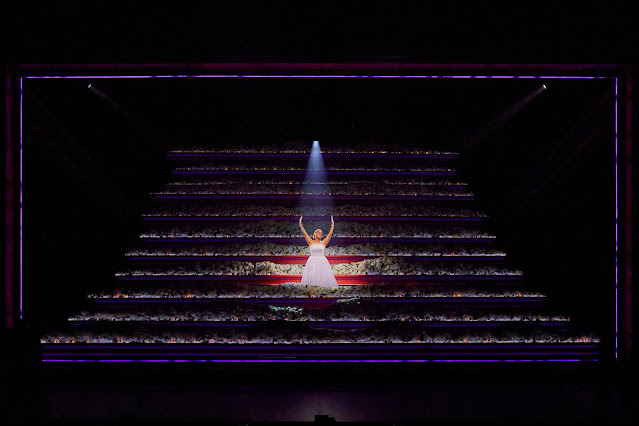
Studio Theatre's Adding Machine: A Musical

Here’s my favorite thing about the Studio Theatre. Occasionally there is a new play or musical running on or off-Broadway, and I’m really excited about it. But time or money interferes, and I can’t get up to New York to see it. Chances are, within a year or two, Studio will produce that play or musical.

So it happened with Adding Machine: A Musical by Joshua Schmidt and Jason Loewith. I very much liked the original play, The Adding Machine, by Elmer Rice, when I read it while studying Expressionism. When I heard there was a new musical based on that play, I had to see it.

And this musical is a very successful adaptation. It follows the plot and script of the play quite closely. The plays and musical tell the story of Mr. Zero, who is, essentially, a living cog. He is a cog in the machine of his job. He works as an accountant, in America in the 1920’s. He has worked the same job for 25 years. The boss comes to talk to him. But instead of the expected promotion, the Boss fires Mr. Zero, replacing him with an adding machine. Mr. Zero snaps and kills his boss, is tried and sentenced, and executed. He ends up in the Elysian Fields, finally finding peace at an adding machine, where he would be content to add numbers all day long. But he’s told he has to return to Earth for another go around.

Writers Schmidt and Loewith follow directly the letter of the original play, but they make a fascinating shift with the work. Rice’s play is an anti-technology piece, distrusting and skeptical. Mr. Zero is the anti-hero, but he is also a victim. He is a cog in the machinery of employment, but also a cog in the machinery of life. Schmidt and Loewith don’t let Mr. Zero get off so easily. The piece becomes less about the threat of technology and more about the complacency of Mr. Zero. He is also at fault for choosing the life he chooses, for choosing not to advance, for being afraid to reach higher, for being afraid to love.

It’s a smart and thought-provoking adaptation, given a fine mounting by Studio Theatre, with David Benoit giving a credible performance as our everyman, Mr. Zero. Though set in the past, it’s a thoroughly modern musical, with a musical score that will not be to the tastes of the old-fashioned, but which completely fits in the dystopian world of the story.

3 stars
Through November 15

Neil Simon's place in the American Theatre

Sometimes when writing about the productions I see, I get wrapped up in the “review” part to the detriment of the “blogging” part. And the blogging part is the part that it is more interesting to me. By this I mean, I keep thinking, “Oh I need to talk about the actors, and the set, and the direction” that I don’t always have time to just muse on the questions that I am left with about how and why a certain piece of theatre works and doesn’t work. So I’m going to do a more blog post as opposed to a strictly review post and talk about Neil Simon.

These thoughts come about having seen Theatre J’s production of Lost in Yonkers, which is getting positive reviews, amidst the news of the failure of the Broadway repertory productions of Brighton Beach Memoirs and Broadway Bound.

Many people are wondering about the failure of the Broadway production and how it happened. The Playgoer has a fascinating post about it. Neil Simon used to be a god of the Broadway stage. He is one of the most often produced American playwrights; I think you would be hard pressed to find a community theatre that didn’t produce a Simon play at least once every few years.

Community theatre. There we come to it. There is no denying that currently the place of Simon is squarely set in amateur theatre. But what does that mean? Does it mean the plays are bad? Lacking in sophistication? Or just wholesome and easier not to mess up? Maybe they are so well written that they play themselves making it possible for untrained actors to succeed in them.

I wonder how many people in the professional theatre have the ambivalent Simon feelings that I have. It is easy for my elitist, snobbish side to dismiss his plays as “standard community theatre fare.” But if pressed, I also have to admit that I have a certain affection for Simon plays in spite of? / because of? their status as standard community theatre fare.

I would bet that like me, many of you started in community theatre. That’s where I grew up, and so I cut my teeth on Neil Simon plays. One of my first speaking roles in an adult show was as Laurie in Brighton Beach Memoirs. For my high school drama club I played Olive in The Female Odd Couple, a character who is onstage for all but 5 pages of the script. That was the first time I had had a role that large. In fact, I don’t think I’ve had any other role that large.

I can remember, when I was younger, defended Simon against those who dismissed him as writing the same play over and over, and just being a joke a page writer. I think there is truth in both those statements, but I argued that besides writing jokes, Simon wrote people. I thought his jokes were always rooted in humanity. I objected to the film of Carol Burnett in Plaza Suite because I thought she played the jokes, and not the characters.

And yet. And yet. There was still hesitation on my part as I sat down to see Theatre J’s production of Lost in Yonkers, directed by Jerry Whiddon. Watching this fine production, I still couldn’t shake the feeling that I was watching a community theatre play, being performed by professional actors. The acting really was excellent, especially Holly Twyford’s Bella. Twyford created a remarkable character, carrying the evening, and rising above any sort of preciousness or caricaturization. But because it was Simon, there was this skirting of darkness; you always knew everything would turn out okay, so dramatic tension was lacking, there was no real danger; a lack that I think is inherent in the text.

Was Simon popular in a time when people craved that sort of warm reassurance that he provided? Do people who see theatre now no longer want that? Or at least, people who pay $50-100 for a ticket? Or is the failure of BBM and BB not a question of artistic value, but one of financial mismanagement?

Let’s just think for a moment about another play I saw recently. Angels in America, produced by Forum. A production that I can’t stop praising. What is the difference between the type of play that Angels in America is and the type of play that Brighton Beach Memoirs, or Lost in Yonkers is? Why will a community theatre produce the latter, but not the former (I mean, besides the full frontal male nudity)? Is the difference in the kinds of questions the plays leave us with? Does Angels in America ask harder questions of the audience than Lost in Yonkers? I think so. But are the more difficult questions more valuable?

Okay, in all honesty, I would probably answer YES. But that’s because that’s the kind of theatre-goer I am. Theatre as education, Art with a capital A, and all that. (I warned you that I could be pretentious). But I know that that is not why all people go to the theatre and that theatre as entertainment is a viable medium as well.

So the failure of Brighton Beach Memoirs on Broadway has us asking, where is Neil Simon’s place in the American theatre? I say he has one, all genres of plays do, but where is it? If a Neil Simon revival cannot succeed on Broadway, does that mean his plays have not reached the status of classic? Are they bound to a certain place and time? Is Neil Simon’s place non-professional theatre? If that were true, is that a judgment on the quality of his plays, or merely the genre of his plays?


By the way, Lost in Yonkers runs through November 29. I give it 3 stars.

Tuesday, November 10, 2009

Folger's Much Ado

Milling about in the Folger Theatre lobby before the show begins, patrons are greeted with reggae music playing over the speakers. Upbeat, fun, funky, light. As we enter the theatre, we are greeted by a Caribbean set, colorful and exciting. Upbeat, fun, funky, light, colorful, exciting – all things that a production of Much Ado About Nothing should be. Unfortunately this production, directed by Timothy Douglas, fails in every respect.

I’m not even sure where to start. With the fact that Beatrice (Rachel Leslie) and Benedick (Howard W. Overshown) have no chemistry? With the fact that not a single member of the cast seems able to land a joke? With the fact the Folger apparently can’t assemble a full cast and Douglas seems to have never heard of double-casting, leading to a confusing conflation of characters that obscures the plot?

Let’s start with the biggest problem, the lack of funny. Someone needs to explain to this cast that Much Ado About Nothing is not a Pinter play, therefore excessive pausing is not only unnecessary, it’s harmful. For an example, when Claudio asks (referring to Hero), “Can the world by such a jewel?” Benedick responds, “… Yea. … … And a case to put it into.” Likewise, Benedick and Beatrice pause during their battles of wit before each response. Wit is fast and furious. Light and delicate. Benedick and Beatrice are smart. Very smart. But if they have to stop to think up their retorts, the way that Leslie and Overshown do, well, they don’t come across as very bright. Overshown and Leslie also mug to the audience too much, as if to say, “Look, I just said something funny!”

There isn’t a lot of fun to be found anywhere else either. Alexis Camins as Claudio, Doug Brown as Leonato, and Jeffrey Scott as Don Pedro (understudy) seem to be having a contest of who can most successfully imitate cardboard. After Hero has been shamed, Antonio (Craig Wallace – sadly stuck in this production as a conflation of the messenger and Antonio and referred to in the playbill as “Brother”) tells Leonato to calm down. But it doesn’t make any sense, because we haven’t seen any real rage from Brown.

I can’t speak to the talent of Dionne Audain because the poor woman is given the role of Borachio, a casting decision that makes no sense whatsoever, and in fact harms the play. Douglas chooses to show the duping of Claudio, so we see Borachio and Margaret together up on a balcony. The audience is then given the impossible task of caring about Claudio, a man so stupid he can’t tell the difference between Margaret and Hero AND can’t tell that the other person with her is in fact A WOMAN.

Douglas seems to think all the characters in this play are stupid. Borachio gets caught because she tells her tale to Verges (Matt MacNelly – actually playing a conflation of Verges, Conrad, Watch 1, Watch 2, Watch 3) because there is no Conrad in this production. And Douglas makes Don John (Joel David Santner) into a fop. He wears tight leather pants, acts like a frat boy, dances, and smiles even though the text clearly says he is melancholy.

I will say that I loved what they did with the ‘Hey Nonny Nonny’ song, and the music and dance at the end of the play. These two moments had all the fun, energy, and whimsy that was lacking from the entire rest of the production.

Two stars
Through November 29

Forum Theatre's Angels in America

Why are you reading this blog? Why aren’t you on Forum’s website right now buying tickets to both parts of Angels in America? Perhaps you’ve already seen it, and are here to celebrate with me all that is glorious about the production(s). Repeat after me: the cast! the script! the direction! the technical design!

Forum Theatre is giving DCers a wonderful opportunity to see both plays in rep. More often than not, Angels in America Part I: Millennium Approaches is performed alone. And you can see why. If you are only going to do one part, the first one is the one that makes the most sense alone. But to only see Millennium Approaches is really to miss out on the epic work which playwright Tony Kushner wrote.

There are three main plots woven through the story. In the main one, we meet Prior Walter (Karl Miller) a gay man who has just become ill with complications from AIDS. His lover, Louis Ironson (Alexander Strain) leaves him, unable to cope with the pain of watching Prior die. The relationship of Mormon couple Joe Pitt (Daniel Eichner) and Harper Pitt (Casie Platt) is also under strain. Harper is not quite mentally balanced, caused partly because the young wife knows deep down that her husband is a closeted homosexual. In the third plot, Kushner uses real life attorney Roy Cohn (Jim Jorgensen). Cohn was a conservative, powerful lawyer well known for his work on anti-communist cases during McCarthy’s investigations. In Angels in America, we meet him as he is dying of AIDS, knowingly deceiving himself and insisting all the while that it is liver cancer.

At the end of part one, an Angel bursts into the bedroom of Prior Walter, informing him that he is a prophet. If you only see part one, it might be easy to dismiss Angels in America as dated, as simply “an AIDS play.” But Part Two: Perestroika proves that this work isn’t dated, that it is about so much more. It is in part two where the play truly reaches that status of a great work of drama. Because in part two the play expands into being about the condition of humanity. The Angel tells Prior that God has forsaken heaven, and that Prior and the rest of humanity need to remain still so that God will return. Stillness. Lack of progress. Complacency. Death. But Prior refuses, “This disease will be the end of many of us, but not nearly all, and the dead will be commemorated and will struggle on with the living, and we are not going away. We won't die secret deaths anymore. The world only spins forward. We will be citizens. The time has come.”

Prior refuses to stand still for himself and for humanity. And the other characters, through their journeys, make the same decision. Harper, who has spent much of the play in a drugged haze, is able to finally gather her strength and leave her husband. All she has wanted was to get him back, and when he does come back, she realizes that she can’t have it the way it was; she cannot stand still; she must move forward. Louis faces his demons, and stops running. He too finds the strength needed to love Prior, and though their relationship cannot be what it once was, a new one is forged.

Under the smart direction of Jeremy Skidmore and Michael Dove and the talents of the cast, this production of Angels in America showcases everything that is great about the play. Signature Theater in New York will be reviving this work off-Boadway next season, but I can assure you, they will not be able to assemble a cast that does more justice to the text than the one you can see right now at the Round House in Silver Spring.

The two evenings are anchored by the phenomenal performance of Karl Miller as Prior Walter. Miller is delightfully sarcastic, dying and yet full of life, noble and dignified, strong and weak, funny, endearing, and touching. Alexander Strain as Louis and Casie Platt as Harper have the difficult job of playing characters that would come across in a lesser actor’s hands as weak, whiney, and annoying. Strain and Platt never fall into this trap; they are real and sympathetic, and when Louis and Harper finally find their own strength, we are with them.

Jennifer Mendenhall also gives fine performances (no surprise there), especially as Hannah Pitt and Ethel Rosenberg. As Hannah, Joe’s mother, Mendenhall is full of subtly expressed, but deeply felt emotion. And she is wickedly delightful as the ghost of Rosenberg, who comes to joy in the death and defeat of Roy Cohn.

I saw part two about two weeks after part one, and it was wonderful to see a couple of actors grow and settle more deeply into their parts. When I saw part one, I found Jim Jorgensen as Roy Cohn and Daniel Eichner as Joe Pitt good, but slightly flat compared to the other actors. But both revealed more depth and color in part two, giving fine performances. Really these productions have excellent work all around. So go see them. If I may, I shall borrow the capslock briefly from my blogging compatriot. GO SEE THEM.

4 stars
Through November 22

Friday, November 6, 2009

Raining Roses, pelted with poetry.

As You Like It. The Globe Theatre. London 10 October 2009.

This was pretty much the end of the season at The Globe and with their final performance of As You the play concluded with us of in the yard being the recipients of roses. It summed up the play really; a captivating way of spending the afternoon.

We moved seamlessly from the asceticism of the court to the relative liberty of the forest with a few short whisks from black fabrics to more natural tones. Naomi Frederick was a determined and energetic Rosalind whilst Jack Laskey was an endearingly skinny and buggy-eyed Orlando. (Always a good sign, he was one of the best performances in last year’s rather nasty Taming of the Shrew at the RSC.) Tim McMullan was a deliciously pompous aging rouĂ© in the role of the melancholy Jacques. Most of the time he was lapping up his outsider status but genuinely moving as he reaches the sad dĂ©nouement of the seven ages of man. Dominic Rowan was an entertaining and wildly riotous Touchstone whilst a number of the cast did a good job swanning about in fabulous leather costumes.

Marked chiefly by delight this production maybe did not have the intensity and ultimate beauty of the current RSC production, but it filled our afternoon with charm and enchantment.

A sad tale is best for Winter.

The Winter’s Tale. RSC. Courtyard Theatre. Stratford Upon Avon. 30 August 2009.
I love The Winter’s Tale. I know I talk about this quite a lot but it is one of my favourite Shakespeare plays: The possibility of redemption for even those who have made huge, glaring, gut-wrenchingly immense mistakes. Hope for us all.

I had heard a few mixed reviews of this production so I did not have incredibly high expectations before heading along. My old Shakespeare sparring buddy had pulled a face when we talked about it; but then she often does that. I recall quite vividly a heated debate about Leontes (she didn’t want to let him off the hook) so I wandered into the courtyard (rapidly becoming my second home) not necessarily looking forward to what I was about to see.

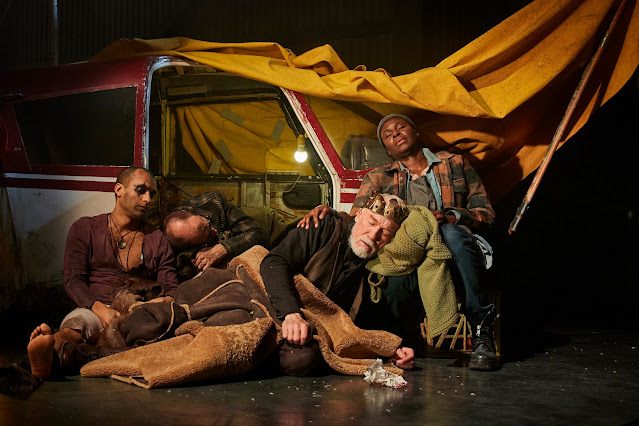
And then the play began and the starkness and tragedy of the first half bowled me over like a freight train. Greg Hicks (Now officially renamed ‘mighty’ by me) was an excellent Leontes; tetchy, passionate, broken, pathetic (In both the actual and everyday sense of the word) and verging on insanity. Katherine Hunter was a restrained Hermione but NOMA DUMEZWENI as Paulina was as sharp as a stiletto.

As the shattering first half rattles to its conclusion the weighty tomes on the shelves surrounding this centre of stability comes crashing down: the chandelier smashes and everything goes awry, nearly collapsing on Leontes as he stalks off stage into the tempestuous wind which blows as the world of order collapses.

However as good old faithful Camillo gets eaten up by the bear (actually very scary in this production; made of paper with glowing eyes as it emerged from the dark) the second half of the play began to falter. Now to be fair this often happens-the transition from tragedy to comedy often wanes but it was the sadly lack-lustre performance from the two young lovers which held this back. For a couple of young lovers flirting and edging round their youthful passions they could have been talking about- I don’t know blancmange, or crochet or fish fingers for all the intensity of their conversations. Following this was there was the less than subtle dance at the sheep shearing which owed more to Big Brother than the pastoral idyll.

I was grateful to get back to the dark, cold land of Leontes. There was a delightful moment when Leontes and his daughter go to see the statue where he hesitantly and with some disbelief puts his hand onto his daughter’s shoulder. A small gesture but brim full of such intense feeling it made me sniffle into my sleeve. And as the statute comes to life and the audience are reassured that life can give people a second chance, I was not the only one with a trickle of brinish tears.

All in all Shakespeare’s brilliant play gets across, but it could have done with a better second half.

Goodnight and farewell.

A few comments on the next phase of As You and Julius Caesar. Stratford upon Avon. RSC.

It has become something of a habit for repeat visits to RSC productions. As the run develops often the production begins to blossom, unfurling gently like a desert orchid.

Now when something starts as strongly as As You Like it did earlier in the year it was a delight to see this production again. Filled with warmth and the sheer joyousness of love this was a production marked by further breathless freshness.

At the end of play I was given a ribbon as part of the celebrations by no other than the legend that is Freshy (Geoffrey Freshwater; what a guy!) and the play finishes with Rosalind singing 'good night and farewell to you all’ concluding the epilogue.

Stephens was even better as Rosalind; flirty, fruity and feeling with Jonjo O’Neil a perfectly charming Orlando. Forbes Masson wowed us again with his falsetto melancholy and Richard Katz boggled the mind with his demented shoes and entanglement with rough patches of bramble.

For those of you that get the chance next year, go and see it upon its return next summer.


Also went to see Julius Caesar again, despite not being overly full of love for it last time. Granted this time thankfully some of the noisy sound effects had been ditched, the wild careering of the dead wife was gone and some of the extraneous stage gubbins had been got rid of, but we will were bludgeoned to death by imagery. By comparison Caesar got off lightly. Still the acting was a fine thing and again Sam Troughton as Brutus impressed as did Greg Hick as Caesar.

Let’s hope another year and it may have moved up a notch.


And they all lived happily ever after?

All’s Well that ends Well National Theatre. London 24 August 2009.

All’s Well is quite a dark play really, for a comedy that is. Similar in tone to Measure for Measure, All’s Well has at its heart the plucky determination of the brave Helena. Doggedly she has set her heart upon the pompous little poltroon Bertram.


In this production Bertram starts off playing about on stage with a toy sword in slow motion matrix style. As he does so he is lit in silhouette with tall shadow-craggy castles looming over and the shade of rooks sweeping over head. The castle is lit with dusky silver giving the whole stage an ethereal yet sinister edge- like true fairy tales.

As Helena makes her way to court to chance her heart the stage become slowly filled with gold but as our intrepid heroine plods slowly along the edge of the gothic ravines all we see is her red cape and sparkly shoes; a cross between little red riding hood and Dorothy in Oz. Visually this was a splendid piece, the stage bathed in bright sparkling radiance or filled with echo-shadowlands. Crowds of victorious soldiers swept in slow mo across the stage wielding flags and cheering, women in vibrant fifties costume gaze on through fairy lit olive groves,

As to performances Oliver Ford Davies was as always excellent in the role of fusty aged King, bumbling and harrumphing his way through ill heath then good. Claire Higgins was excellent as the Countess; imperious enough to be convincing but other than Helena being one of the few sources of warmth in her frosty castle. She seems a vaguely aware that Bertram is a fatuous youth whilst Helena is the true sources of goodness. Given the sparkly shoes and cape for her journey, the countess functions as a kind of fairy godmother.

Michelle Terry as Helena was suitably feisty, donning playboy outfit with fox ears to lure Bertram into the bed trick and Conleth Hill as Parolles was cringy and strangely likeable as he should be.

In the best of all fairy tales this production went for a slightly darker underbelly at the end of the story; more Hans Christian Anderson less Disney. As Bertram and Helena are finally ‘happily’ married- compete with Ok style celebrity photos- the lights dim as the happy couple look out to the audience, staring, bemused, and verging on horrified.

Happily ever after?

Heavenly

Helen. Globe theatre London. August 24 2009.

After an exciting afternoon with Troilus and Cressida it was back to the Globe to see what I think was my first actual Greek play; Helen. A sort of millennia old Monty Python was the way it was billed and it certainly had elements of that.


Plot twists, convoluted and farfetched actions alongside Castor and Pollux providing heavenly intervention and odd jobs (they spent the opening of the play attempting to add building parts to the set and thus followed a The Plank style set piece of missing tools and falling workmen to appear later being winched down from the gods into a wheelbarrow with a thermos of celestial tea.)


The lead was convincingly and passionately evinced by the splendid Penny Downie, who I I have now become an official geek about; feisty, passionate and impelled by the injustice of her situation she was the real Helen who had been replaced by an identikit version by an angry goddess, to be dumped far away on the coast of Egypt whilst her reputation is torn to shreds, her friends and family ignominiously killed in the continuing bloody saga of the Trojan War. She convinced as the desperately sad and wretched woman, the stoic and the lover whose husband is miraculously returned to her.

Menelaus was played with passion and intensity by the rather delightful Paul McGann (Geek note; that’s 4 Dr Who’s in total now!) The fiery relationship between him and his reclaimed wife was joyful, moving and by turns exquisitely funny. At first, realizing his ship has been wrecked and he is pretty much alone upon the shores of a strange land he falls to his knees and was wracked with sobs. Later he, in a fit of teenage effusion, leapt into a passionate kiss with his beloved. The pair were mesmerizing.

Being my first proper foray into the world of Greek drama it took an initial getting used to watching a Chorus singing and the like throughout the story, echoing Helen’s words and sobbing as they realize Helen will leave them in Egypt as refugees. However after a little while one’s mind readjusted to the spectacle and as the play rattled along at a rate of knots so soon became another part of our journey.


The translation by Frank McCourt was muscular and energetic, juxtaposing mildly anachronistic ideas; discussing the gods alongside racist diatribe rant and the occasional rather modern swear word. However this peppering of modern familiarity added to the spicy flavour of the play and created humour and pathos.

The stage was flooded with yellow and golds of Egypt and giant letters (Spelling if I remember correctly LOVE) with a ramp thrusting down into the groundlings to involve us in the action.

This was a vibrant production full of energy, passion and light; farcical, frenetic yet ultimately rather life affirming.

Not bad for a 2000 year old playwright.

Swords n sandals.

Troilus and Cressida. Globe Theatre 24 August 2009. London .Directed by Matthew Dunster

It has been the season for ticking off the ‘unseen Shakespeare’ on the list. Gone was Cymbeline; off the list was Julius Caesar-and at the Globe I could now tick off Troilus and Cressida.
There is something quite refreshing about seeing a 400 year old play and not really knowing the story. Something to do with the Trojan War was about all I knew. The only other few things I knew before heading into the theatre was some of the cast names. Jamie Ballad was apparently playing Ulysses- one of those actors who is always outstanding and who I had seen in two or three different production before. The rather splendid (and splendidly easy on the eye ) Trystan Gravelle and indeed Matthew Kelly.

Yes. That’s right. Matthew Kelly- long lost presenter of cheesy hit TV show Stars in their eyes. That Mathew Kelly.

It was a lovely warm sunny day and after sitting in the queue to get a good view at the front of the crowd and eating a modest repast of beef sandwich followed by delicious and refreshing orange juice (take cover those of you who now the hyperactive effect this induces in me) I got ready to enjoy a little Troilus.
Now in a polite way this was rather a camp production. Matthew Kelly was camper than a row of tents, but with just enough seedy undercurrent to make his Pandarus really rather unpleasant and yet ultimately quite pathetic. There were a lot of rather lovely young men running about in little more than short togas and sandals (beware standing too near the front as at least twice there were a few unsightly moments) and beautiful ladies in thin togas and lots of eye makeup. It was all rather glorious darling, however this highlighted the theatricality and ultimate futility of all the male posturing between the Greeks and Trojans. Achilles (a heavily eye-lined Trystan Gravelle) spent most of the play strolling about in a bit of a big-girls blouse sulk whilst Ulysses (an excellent as always Jamie Ballad) did the thinking for everyone.

Of course as with any good Shakespeare it was not all burly men fighting it out; the passion between Troilus (a young and handsome Paul Stocker.) and the delightful Cressida (Laura Pyper; feisty and convincing.) was tender, youthful and compelling. Which made it all the more saddening to watch its failure after Cressida is taken to the Greek camp. Helen of Troy was a spoilt and lascivious wench, flashing her gold and purple pants a lot at Paris (Ben Bishop; the saddest bit of casting I have ever seen at the Globe; I found it hard to believe she would have run off with him when surrounded by a multitude of handsome Greeks) There was a particularly fine ‘jazz hands’ scene when Pandarus sings to Helen and her cronies. Ridiculous and wickedly funny. Christopher Colquhoun was excellent as Hector; an upstanding a proper chap. So when he is cut down unarmed by Achilles boy-soldiers there were a few huffs and gasps from the audience.
This was rather gorgeous production, dramatic and comic.